In the immediate context of Deuteronomy 29:22–28, the land is not treated as a passive, neutral backdrop. Instead, the land acts as a physical witness and a biological mirror of Israel’s spiritual state.
When Israel breaks the covenant, the land absorbs the divine wrath, shifting from a fertile paradise into a catastrophic wasteland.
1. Biological and Ecological Sickness
Moses states that God will make the land itself "sick". Rather than flowing with milk and honey, it undergoes an ecological reversal:
The Dead Zone Metaphor: The soil becomes a "burning waste of sulfur and salt". Moses uses explicit agricultural negatives to slow the reader down: it is unsown, unproductive, and devoid of even a basic blade of grass. [1, 2, 3]The Sodom and Gomorrah Parallel: The text explicitly compares the geography of the Promised Land to Sodom, Gomorrah, Admah, and Zeboiim—cities completely erased from the landscape by divine judgment.
2. A Global Object Lesson
The devastation is designed to be highly visible and shocking. Moses describes future generations and passing foreigners staring at the ruined geography in absolute bewilderment.
The Questions: International travelers will ask, "Why has the Lord done thus to this land? What caused the heat of this great anger?"The Answer: The response given to the nations points directly back to the covenant: "It is because they abandoned the covenant of the Lord... and went and served other gods..." The land's ruin becomes an architectural signpost of Israel’s infidelity.
3. Eviction and Exile
Because the land is holy, it cannot tolerate covenant unfaithfulness. The climax of the land's reaction is the physical expulsion of its inhabitants. God "uproots them from their land in anger" and thrusts them into a foreign exile. The text demonstrates that ownership of the land belongs to God; Israel’s tenancy on it is strictly contingent upon their loyalty to the King.
The Theological and Practical Meaning of Sulfur and Salt
Moses specifically chooses sulfur and salt (Deuteronomy 29:23) because they represent the ultimate biblical and agricultural symbols of permanent barrenness and total reversal.
The Imagery of Sodom and Gomorrah: Geographically, sulfur (brimstone) and salt immediately evoked the Dead Sea region—the site of Sodom and Gomorrah. By using these elements, Moses warns Israel that breaking the covenant will turn their fertile, well-watered land into a permanent monument of divine judgment.
Agricultural Sterilization: In the ancient Near East, salt was used as a weapon against conquered cities. To "sow a city with salt" (as seen later in Judges 9:45) was a deliberate act of eco-warfare meant to ruin the soil, prevent crops from growing, and ensure the area remained uninhabitable for generations.
The Counterfeit of Fire and Water: The Promised Land was explicitly praised for its abundant springs, rain, and deep soil. Sulfur and salt represent the exact opposite: unquenchable fire and moisture-stripping mineral waste. It signifies that when God withdraws His blessing, the natural order is fundamentally undone.
The Reversal: The Healing of the Land (Deuteronomy 30)
Directly after detailing the total ruin of the soil in chapter 29, Moses pivots to a message of radical hope in Deuteronomy 30:1–10. The moment Israel repents in exile, God initiates a physical and agricultural restoration that mirrors their spiritual renewal.
The Return to Fertile Abundance: In Deuteronomy 30:9, Moses promises that God will make Israel "abundantly prosperous in all the work of your hands and in the fruit of your womb, the young of your livestock and the crops of your land." The sulfur and salt are washed away, and the biological productivity of the ecosystem is completely restored.
The Joy of God: The text notes a profound psychological shift in the divine relationship to creation: "The Lord will again delight in prospering you, just as he delighted in your ancestors." The land transitions from a manifestation of God's hot anger back into a manifestation of His joy. What is the joy of the Lord?
The Spiritual Catalyst (Circumcision of the Heart): The healing of the soil does not happen in a vacuum. Deuteronomy 30:6 states: "The Lord your God will circumcise your hearts and the hearts of your descendants, so that you may love him..." The internal, spiritual transformation of the human heart is what fundamentally triggers the external, physical restoration of the geography.
The Prophetic Vision of an Eden-Like Restoration
The later Hebrew prophets—specifically Isaiah and Ezekiel—witnessed the actual fulfillment of the Deuteronomy 29 curses when the Babylonians destroyed Jerusalem and left the land desolate. When they looked forward to the future restoration promised in Deuteronomy 30, they expanded it into a staggering, cosmic return to Eden.
Ezekiel and the Resurrected SoilEzekiel explicitly targets the mockery of the surrounding nations who looked at the ruined land just as Moses predicted in Deuteronomy 29. In Ezekiel 36, God addresses the literal dirt and mountains of Israel, promising that they will shoot forth branches and yield fruit again Ezekiel 36: 30, 35
Isaiah and the Reversal of the DesertIsaiah takes the "unsown, unproductive" curse of Deuteronomy 29 and completely flips the imagery. Instead of sulfur and salt destroying fertile ground, God’s presence causes the barren desert to erupt with life: Isaiah 35:1, 6-7
Both prophets demonstrate that God's ultimate plan is not just to return Israel to a sustainable piece of real estate, but to completely reverse the cosmic effects of the curse, transforming the ruined, toxic landscape into a thriving oasis of divine presence.
The structural and linguistic connection between Deuteronomy 30:6 and Ezekiel 36:26–27 represents one of the most critical theological bridges in the entire Hebrew Bible.Moses gives the structural blueprint, and centuries later, Ezekiel explains the spiritual and supernatural mechanics of how God will actually pull it off.
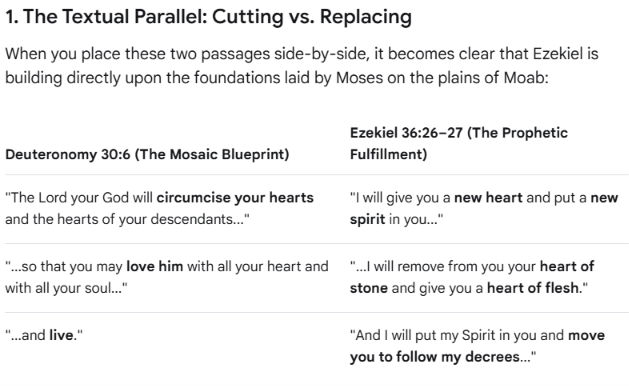
The Textual Parallel: Cutting vs. Replacing
When you place these two passages side-by-side, it becomes clear that Ezekiel is building directly upon the foundations laid by Moses on the plains of Moab:
Deuteronomy 30:6 (The Mosaic Blueprint)Ezekiel 36:26–27 (The Prophetic Fulfillment)"The Lord your God will circumcise your hearts and the hearts of your descendants...""I will give you a new heart and put a new spirit in you...""...so that you may love him with all your heart and with all your soul...""...I will remove from you your heart of stone and give you a heart of flesh.""...and live.""And I will put my Spirit in you and move you to follow my decrees..."
Why the Heart Needs "Surgery"
Both Moses and Ezekiel use intense medical and physical metaphors to describe a profound human problem: spiritual inability.The Stiff-Necked Reality: Right before Deuteronomy 30, Moses laments in Deuteronomy 29:4 that "to this day the Lord has not given you a mind that understands or eyes that see or ears that hear." The people are fundamentally incapable of keeping the law on their own power.
The Heart of Stone: Ezekiel diagnoses this exact same disease. A "heart of stone" is dead, unresponsive, unyielding, and utterly petrified. You cannot reform, train, or educate a stone. It must be completely removed.
The Radical Solution: Moses’s metaphor of circumcision implies cutting away the dead, stubborn outer layer of the human will. Ezekiel takes this surgical metaphor to its ultimate surgical conclusion: a literal transplant. The old, dead organ is extracted, and a soft, responsive "heart of flesh" is put in its place.
The Divine "I Will"
In both passages, the absolute sovereignty of God is the driving force. In the previous chapters of Deuteronomy, Israel was commanded to circumcise their own hearts (Deuteronomy 10:16), which they completely failed to do.By the time we reach Deuteronomy 30 and Ezekiel 36, God takes over the operation entirely. Ezekiel 36 is famously driven by a relentless rhythm of divine declarations: "I will clean you... I will give you... I will remove... I will put my Spirit in you."
The Result: Spontaneous Obedience and Land Healing
For both Moses and Ezekiel, this internal heart surgery is the exact trigger required to solve the centuries-old problem of covenant infidelity.Once the Spirit is placed inside the human chest, obedience is no longer a crushing external obligation—it becomes an internal, natural desire. And the moment the people are spiritually aligned with God, the land is instantly healed of its sulfur and salt. As Ezekiel 36 notes immediately after the heart transplant: "You will live in the land I gave your ancestors... I will call for the grain and make it plentiful." The internal resurrection of the human spirit directly commands the external resurrection of the soil.
Writing around the same time as Ezekiel during the collapse of Jerusalem, the prophet Jeremiah uses a slightly different metaphor—writing the law on the heart—to describe the exact same spiritual transformation outlined in Deuteronomy 30 and Ezekiel 36. Jer 31:33
From Stone Tablets to Living Flesh: At Mount Sinai, the law was etched onto external tablets of stone. Because the law remained outside of the people, they could easily turn away from it. Jeremiah argues that the New Covenant solves this by changing the medium. God takes the exact same law and etches it directly onto the internal consciousness and desires of the human being.
The Guarantee of Continuity: In Deuteronomy 29, the covenant failed because it relied on human memory and willpower across generations. Jeremiah’s "written on the heart" model guarantees that future generations will naturally know God: "No longer will they teach their neighbors... because they will all know me, from the least of them to the greatest" (Jeremiah 31:34). It provides the permanent, unbreakable link that Moses’s transgenerational covenant lacked.
Paul’s Application in Romans 2 and 2 Corinthians 3
The Apostle Paul pulls all of these threads together—Moses’s circumcision, Ezekiel’s transplant, and Jeremiah’s writing—to redefine the boundaries of God's covenant family in the New Testament.Romans 2: The Definition of a True JewIn Romans 2:28–29, Paul uses the precise vocabulary of Deuteronomy 30:6 to argue that true covenant membership has always been an internal reality, not just an external, physical marker.
Paul takes Moses’s prophetic promise from Deuteronomy 30 and claims it is actively being fulfilled in the first century through the Holy Spirit. By defining covenant belonging through the spiritually circumcised heart rather than physical descent, Paul expands the "whoever is not here with us today" from Deuteronomy 29:15 to include Gentile believers from all over the world.
2 Corinthians 3: Tablets of Human Hearts
In 2 Corinthians 3:3, Paul explicitly bridges Jeremiah and Ezekiel to defend his ministry, telling the church that they themselves are a living letter from Christ.
Paul contrasts the "ministry of death" engraved on stone at Sinai with the "ministry of the Spirit" taking place under the New Covenant. The stone tablets of the law could only condemn Israel and bring about the sulfur and salt of Deuteronomy 29. But the Spirit, by enacting the heart transplant promised by the prophets, brings about the life and resurrection Moses promised at the end of his final speech.